Personal and Professional Digital Identity, VR Mapping
VR Mapping
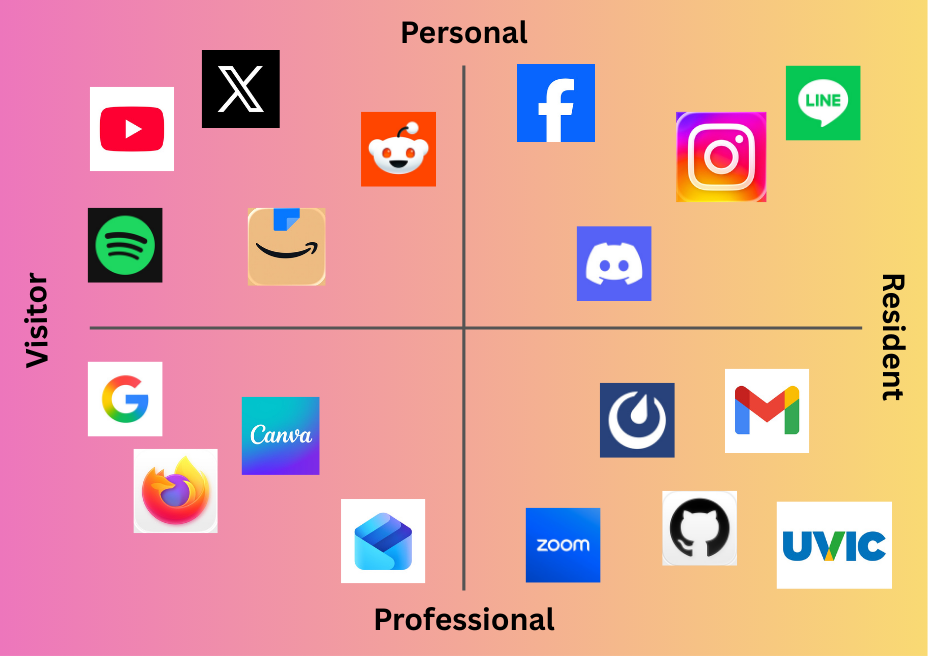
This Visitor and Resident Map was created based on the framework outlined by OCLC in the Visitor and Resident mapping exercise.
In this map, I identified approximately eighteen applications and websites that I currently use in my everyday life. The placement of each icon represents how I perceive my level of engagement, ranging from Visitor to Resident, as well as whether the platform is used more for personal or professional purposes.
Reflection
While creating and reviewing my Visitor and Resident Map, several patterns emerged that I had not previously been fully aware of :
1. A clear separation between personal and professional spaces
One of the most noticeable patterns was how clearly separated my personal and professional digital spaces are. Platforms such as Instagram, LINE, Facebook, and Discord are positioned in the Personal × Resident area, while Gmail, GitHub, Zoom, and UVic-related services fall into the Professional × Resident quadrant.
Reflecting on this, I realized that I may have been unconsciously adjusting my behavior depending on the context, much like how people naturally change their conduct based on their physical environment. This suggests that my digital habits are shaped by an awareness of space and audience, even when that awareness is not always explicit.
2. A strong presence in the Resident–Professional space
Another pattern that stood out was the strong concentration of platforms in the Resident–Professional quadrant. This likely reflects my current academic and professional situation. As a Computer Science major in my fourth year of university, I am at a stage where academic work, skill development, and career preparation play a central role in my daily life.
The prominence of professional platforms in this area suggests that I am consistently “present” in spaces related to learning and work, rather than engaging with them only occasionally. This aligns with my growing focus on employability and long-term career development.
3. Personal-Visitor platforms focused on consumption
Looking at the Personal–Visitor side, a clear tendency toward consumption became apparent. Platforms such as YouTube, X, Reddit, Amazon, and Spotify are primarily used for entertainment, information gathering, and exploration, rather than active participation or self-expression.
This indicates that, in these spaces, my role is largely passive. I consume content rather than contribute to it, which contrasts with the more engaged presence I maintain in Resident spaces. This distinction helped me better understand how differently I interact with platforms depending on my intentions and expectations.

Consideration Questions
Q. What digital platforms are students currently using to develop their professional network?
Students commonly use platforms such as GitHub and company websites to develop their professional networks. In my own experience, professional connections are often built through personal email exchanges with people I encounter via company websites, as well as through conversations held on Zoom. These platforms allow for more direct and practical communication that is closely connected to academic and professional activities, making them especially valuable for professional networking.
Q. What could the student consider in expanding their professional learning network?
It is important to approach it separately from personal use and to avoid relying too heavily on a single platform. Even in my own case, I already use several different types of networks, and by broadening the range of platforms I engage with, I believe there are more opportunities to connect with a wider variety of people.
Ideally, the most effective way to expand a professional learning network would be to quickly identify individuals or communities that share similar goals and values and deepen those connections. However, this is not always realistic. A more practical approach is to first increase the number of people one encounters, and then gradually identify the professional learning networks that best align with one’s goals. At the same time, it is important to remain conscious that these platforms are being used in a professional context and to avoid letting them shift too far into personal use.
Q. Consider how an employer would respond if they assessed your social media presence via your digital identity.
I believe that I maintain a clear distinction between my professional and personal digital identities. As a result, even if an employer were to assess my digital identity, I do not think it would create a negative impression or raise significant concerns.
This is largely because I am careful about the content I share on my personal social media accounts. My posts tend to focus on light, everyday topics, such as places I have visited, meals I have enjoyed, recent activities, or personal memories. By keeping my personal content neutral and non-controversial, I feel that it is unlikely to negatively impact professional evaluations.
Resources Used:
- Visitor and Resident mapping framework by OCLC – https://www.oclc.org/content/dam/research/activities/vandr/resources/vr-mapping-exercise-sheet-definitions-20190329.pdf
- Canva (used to create the visual map) – https://www.canva.com
Very thoughtful post! The point about adjusting your behavior based on context sticks out to me: my background is PSYC + CSC, so I’m quite interested in the bidirectional relationship between virtual spaces and our behavior within them (ex. behaving in a certain way while using a social media app because of the features it provides, then customizing it to further suit your behavior, which may lead to more support for that use case from the developers). It’s much like how a physical space can become gentrified, specialized, etc., depending on its own characteristics, the audience it serves, and how those change over time.
I really enjoyed reading your post !! I liked how detailed and organized your reflection was, especially the way you explained why certain platforms fall into each quadrant. The connection you made between your academic stage and your strong presence in professional spaces was really clear and made the map feel purposeful. I also found your point about consumption-based platforms helpful in showing how engagement differs across spaces.